
Multiple sclerosis is a frightening and unpredictable disease accompanied by various daily symptoms (mental and physical). This disease is associated with impaired functioning of the central nervous system, in which disruption and damage to the flow of information in the brain and entire body are noted. Observing people who have been diagnosed with multiple sclerosis, one can notice significant changes in a person and hear the pain that this disease causes. In this overview, you can learn in more detail about the features of multiple sclerosis development in a person, as well as about the 5 most common educational games.
Features of Multiple Sclerosis Development
Multiple sclerosis can provoke various changes in the human body – cognitive, behavioral, and physical. The most noticeable are cognitive changes, which are perceptible even when talking to a sick person on the phone.
The most common problems are memory problems. People suffering from multiple sclerosis face different degrees of memory loss. According to the National Multiple Sclerosis Society (NMSS), it is known that in 50% of cases, a person with multiple sclerosis manifests certain types of cognitive impairments. For this reason, regular training of mental abilities is called an important condition for maintaining health.
Specifically for this purpose, all kinds of educational games have been developed that stimulate the mind and memory. Let’s consider the 5 most common games.
#1: Sequencing Games
These games are aimed at improving problem-solving skills: for example, developing flexibility of thinking and logical reasoning. It is recommended to record how much time was spent on a specific sequencing game. Later, you can compare the results obtained in order to understand what results and successes have already been achieved.
The list of sequencing games includes solitaire, dominoes, and sudoku. You need to start with simple games and levels. For example, when choosing solitaire, you can start with the simple “Klondike” variant, and then move on to the “Spider” variant. For benefit without overloading the brain, short sessions of 10-20 minutes per day are sufficient.
#2: Puzzles
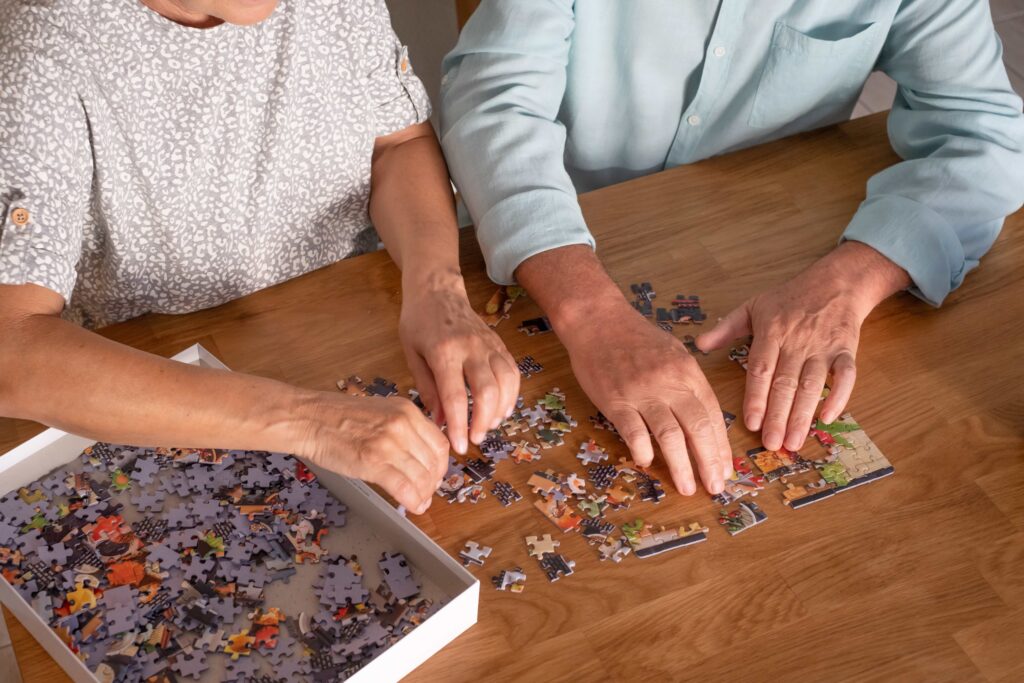 This game is used to develop visual perception skills. In this case, you can also time yourself and compare the results each time when assembling specific types of puzzles. For this, you can start a separate diary or create a table that will indicate the dates and exact time of completing the game. As a result, you can understand after what time interval significant improvements are observed.
It is not necessary to use standard puzzles; you can also download the game on smartphones and computers.
To start, you can use simple puzzles designed for 20-50 pieces, and only gradually increase the difficulty. So that a person does not get tired and really gets maximum pleasure from the process of assembling a picture from separate elements, it is necessary to do short sessions.
#3: Scrabble
This board game is aimed at actively developing problem-solving skills. It helps to learn to organize thoughts, think logically, develops language abilities and mental flexibility. You can play the game with friends, with family members, or on a smartphone by downloading virtual Scrabble.
Scrabble is a game in which players compose words from random letters on a game board. When choosing such a game, you should remember several main rules:
- It is necessary to start with short games or choose games with a minimum number of letters. This is important in the initial stages so as not to overload a person’s cognitive resources.
- In case of problems with hand motor skills, it is best to use the electronic version of the game or choose large letters.
- You need to play with support – for example, family members or friends. As a result, the game will be maximally socially active.
For variety, you can combine Scrabble with other memory or logic games.
#4: Search and Find
Games for searching for various objects are also called no less effective. They contribute to the active development of visual perception skills and the speed of processing various information.
The list of the most common games includes word or number searches, mazes, and searching for hidden pictures.
#5: Crosswords

This is one of the most popular and beloved games. It has been proven that daily crossword solving (even for a short time) contributes to improving cognitive functions. Moreover, we are talking about functions that are directly related to organizing information, solving various tasks, flexibility of thinking, and speech development.
Useful recommendations:
- To start, you need to choose the simplest crosswords in order to gradually increase their difficulty level.
- If there are some problems with hand motor skills, it is recommended to consider the option of electronic or adapted versions.
- Regularity is much more important than intensity, so even 10-15 minutes a day bring special benefits to the human brain.
Crosswords can and should be combined with other no less useful cognitive exercises: for example, puzzles, logic problems, and memory games.
Brain Plasticity or Neuroplasticity
Neurons in the human brain are often compared to muscles, and therefore they must constantly work. Brain plasticity or neuroplasticity is a unique ability of the brain to recover and restructure. Thanks to this adaptive potential of the nervous system, the brain gradually recovers after injuries or various nervous disorders. As a result, it is possible to reduce the negative consequences associated with changes in brain structure, which are often caused by the following pathologies: multiple sclerosis, Parkinson’s disease, cognitive impairments, Alzheimer’s disease, dyslexia, ADHD, insomnia, and others.
Therefore, you should choose all kinds of games that allow you to spend time in a fun and beneficial way while training your brain.